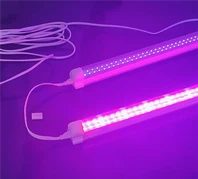
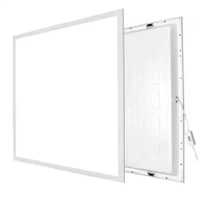
The 2 foot and 4 foot lighting fixtures have been lighted by linear fluorescent bulbs for a long time. Fluorescent troffers are a common name for these fixtures. The AC bus lines above the suspended ceiling are linked to the troffers. The light generated by the lamps may be shaped by a fluorescent troffer using components such a sheet metal enclosure, a fluorescent ballast, fluorescent lamps, and optics to create an aesthetically pleasing light for the context in which it will be used. All across the world, commercial buildings and industrial settings frequently include lighting fixtures in the troffer design. Nevertheless, the issue of relatively high power consumption is caused by the standard fluorescent bulbs' very low power factors and short life cycles, which range from 3,000 to 4,000 hours. In addition, the waste stream is drawn in by the removed lighting fixtures or components for disposal or recycling. As a result of the toxic or hazardous materials in the removed components, including PCBs in the ballasts and mercury in fluorescent lights, disposal raises major environmental problems. As a result of LED's benefits in terms of high efficiency, low power consumption, high reliability, quick reaction time, and low failure rate, the lighting industry and academics devote time and effort to expanding lighting applications using LED.

The use of light emitting diodes (LEDs) in general lighting fixtures for settings like conference rooms and offices is becoming more widespread. An interesting lighting device in recent years is the LED flat panel light. A significant amount of the commercial, office, and retail space has suspended ceilings. An LED panel light is made to give enough lighting to take the place of the existing fluorescent lamps with varying lux levels. Direct-lit backlight modules and edge-lit modules are two of the main types of lighting panel architectures. A group of LED light sources that are placed directly underneath a panel make up a direct-lit LED panel. But keep in mind that LEDs are a type of directed light source whose Lambertian light output intensity is highest at 90 degrees. Since LEDs are pointed directly towards the light diffusing layer, the light they emit shines straight onto the layer. It thus produces a point source of light that may be bothersome or damaging to someone's eyes. Hot spots (i.e., the area with the highest light output intensity) can be seen in a direct-lit light panel with the diffuser layer placed too close to the LED light sources.
The development of edge-lit LED panel lights is predicated on achieving a fixture that generates a light output that, to the human eye, looks uniform throughout the diffuser panel by balancing the relationships of the aforementioned parameters. Light is carried from an LED array to the central part of an edge-lit panel by light guides in modern LED flat panel lights developed primarily utilizing the edge-lit backlight theorem. The usage of edge-lit LED panels in indoor lighting fixtures is rapidly gaining popularity. It is now feasible to find a substantially flat LED panel with edge lighting, enabling tiny panels with adjustable length and breadth that produce uniform light. The lighting fixture and related retrofit kit provide a tool with a ton of installation flexibility. By including one or more diffuser devices, edge-lit LED light panels may provide an ambient white that covers the whole front face of the panel evenly. In general, an LED panel may be split into a frame and light emitting devices that are enclosed by the frame. The aluminum frame supports the structure, contains the LED panel's parts, including the LED strips and power electronics, and dissipates heat. A light guide panel has many SMD LEDs placed next to two or more of its borders. Edge lighting uses SMD2835, SMD5630, SMD3014, SMD4014, and other SMD light sources.
It is possible to find edge-lit LED panel lights, which couple light onto the edges of a planar light guiding panel (waveguiding medium). The light is propagated across the whole volume of the material by complete internal reflection before being released from a light-emitting face. In order to ensure that the light emanates from the LGP's front face, light from the LEDs penetrates the LGP's edges and is redirected inside. A reflector can be added on the panel's rear surface to redirect light that would typically escape the panel's back surface toward the front surface. The back face of the panel, which is the face opposite the light producing face, will commonly include a light reflecting layer in order to reduce light emission from the rear face. One or both faces of the light guiding panel may have a surface pattern made up of a surface roughening that disrupts the light guiding characteristics of the LGP at the site of the region creating a preferred emission of light at the area in order to promote a uniform emission of light. The light will move within the waveguide as soon as it enters. The quantity of light that will emerge from the waveguide's edges can be controlled by attaching diffusers and/or reflectors to the edges other than the one that is exposed to the light source module. In order to direct the light from the waveguide's principal flat surfaces in a diffuse or angled fashion, features on the waveguide may be used. To extract diffuse light, characteristics including laser etching, chemical etching, and form painting are now applied. Microlens light distribution characteristics can be used as an option to offer a more specialized and personalized light output.
Yorug'lik dan LED panel
The diffusing panel is often made of transparent plastic or light-transmitting plastic with a consistent surface pattern to enable even light emission. To avoid any unevenness, the diffuser may be manufactured from a blend of diffusing agents. In order to eliminate hot spots, the diffuser's compounded diffusing material may scatter the light from the LED light source. To guarantee that the light distribution for the LED panel is Lambertian or very close to Lambertian, diffusers made of poly (methyl methacrylate, or PMMA), polycarbonate, and/or polystyrene are used in LED panels. Using a reflecting material or reflector located on the back of the light panel, light that has been evenly dispersed over the panel will be diffused and directed through the panel into the area to be lighted. A waveguide or light pipe feature may be used to direct light from edge-lit LEDs into the center of the corresponding panel, which can help ensure uniformity of the light generated by LED light panels.
Office lighting environments predominantly use LED light panels. Since a variety of human demands must be met by workplace lighting. A workplace's lighting may therefore be judged to be of excellent quality if it makes it easy and comfortable for employees to do their visual jobs. Parameters like lux for intensity, CRI for color rendering index, and Visual Comfort Parameter (VCP) for glare are used to evaluate the light quality. Recently, the International Commission on Illumination's (CIE) Unified Glare Rating (UGR) recommendation has gained widespread acceptance as a standard glare evaluation method. Although edge lighting panels have several advantages, some of them include their consistent illumination, streamlined design, and tiny profile. However, edge-lit LED panel lights have the drawback of ineffective UGR regulation. Glare formation is a result of insufficiently managed UGR, which can be quite dangerous in big spaces. This is especially true for sizable spaces, such as conference rooms, utilized in workplaces. Uncomfortable glare might result from UGR values more than 20, especially in the office or room settings mentioned above. Therefore, edge-lit LED panels used in workplaces are preferable to have a UGR of 19 or below.
Edge-yoritilgan LED panellari% 2c ortib borayotgan nurli samaradorligi hali boshqa to'siq. Yorug'lik samaradorligi ning kotirovkasi the the total luminous flux generated the LED panel light and the umumiy quvvat kirish u qabul qiladi. It aniqlanadi nisbat sifatida nisbat nurli oqim (Lm) dan qo'llanilgan quvvat (Vatt). The measurement unit is lumens per watt (lm/W). Chunki yorug'lik yo'qotishlari ichida yorug'lik yo'qotishlar yorug'lik yo'qotishlari in kupling light into the medium, and losses in extracting light from the medium, edge-lit lighting panellari bor a past nurli samaradorligi dan ortiq to'g'ridan-to'g'ri yoritilgan konfiguratsiya qotishma. Edge-lit LED luminaires emit emit aks nur nur bilan yorug'lik odatda 80 va 100 lm/W, sifatida kontrast to to to g to g lik yoritilgan panellar ta'minlaydi yo'naltirilgan yorug'lik nurli samaradorlik as as sifatidayuqori as 160 lm/W.
2c bir asosiy foyda an edge-lit LED panel chiroq ustidan a orqa-lit yoki to'g'ridan-to'g'ri yoritilgan panel chiroq bo'lgani bo'ladi u ancha ko'proq ixcham. Alohida, 2c ning umumiy qalinligi chiroqning qalinligi 2c bo'ladi qalinligi ga o'xshash bo'lishi mumkin qalinligi yorug'lik-yo'l ko'rsatuvchi panel, yasash mumkin mumkin uchun mumkin qurilish panel bilan qalinligi 8–12 mm. Bundan tashqari, LED paneli har qanday o'lchamda bo'lishi mumkin.. Misol uchun, the LED panel bo'lishi mumkin kvadrat va o'lchov atrofida 24 dyuym (600 millimetr by 600 millimetr), bo'ladi past o'lcham of a normal fluorescent ceiling troffer. Due to ularning keng oralig'i o'lchamlari 2c ular ko'proq moslashuvchan va bo'lishi mumkin foydalanish uchun a xil xil maqsadlarda. Alyuminiy ramka berilishi mumkin a termoplastik statik qoplamaga qarshi. Ramka's kumush yoki oq rang integral yaxshi bilan ikkala turar-joy va biznes shiftlari, va u shuningdek korroziya va chizish chidamli.
Tashqi doimiy oqim drayverlari bilan mumkin dimlama umuman kuchlanish LED panel chiroqlari. Ular standartda kelish 2c DALI, va analog formalar, as well as as turli rang harorati. Ular bo'lishi mumkin yuzasi o'rnatilgan shiftlar va devorlar, sifatida pendants, yoki o'rnatilgan to'g'ridan-to'g'ri ichiga an'anaviy to'xtatilgan shiftlar va dam olish joylari. Uning yuqori ishlashi birlashtirilgan bilan kam energiya iste'mol, a uzoq umri, va a sleek dizayni uni eng yaxshi variant uchun qiling uchun eng yaxshi variant umumiy maqsad yoritish ofis binolarda binolarda 2c katta chakana muassasalar, ta'lim muassasalari, davlat, sog'liqni saqlash, va shifoxonalar.